A lighthouse on the cliff
The brick tower stands 20 meters from the edge of the cliff, 27 meters above the Baltic. The walls are 95 cm thick at the base and 60 cm below the gallery, and the tower tapers toward the top to stand up better to the wind off the sea. The light burns 58 meters above the water.
- Granite plinth from Kashubia, 1.8 m high. The stone came by cart from Krokowa, the brick by barge from Puck.
- White cornices every two floors. From the sea they divide the tower into bands, so sailors can tell it by day.
- Gallery at 55 m above sea level, with a cast-iron railing. Guests can come up here until sunset.
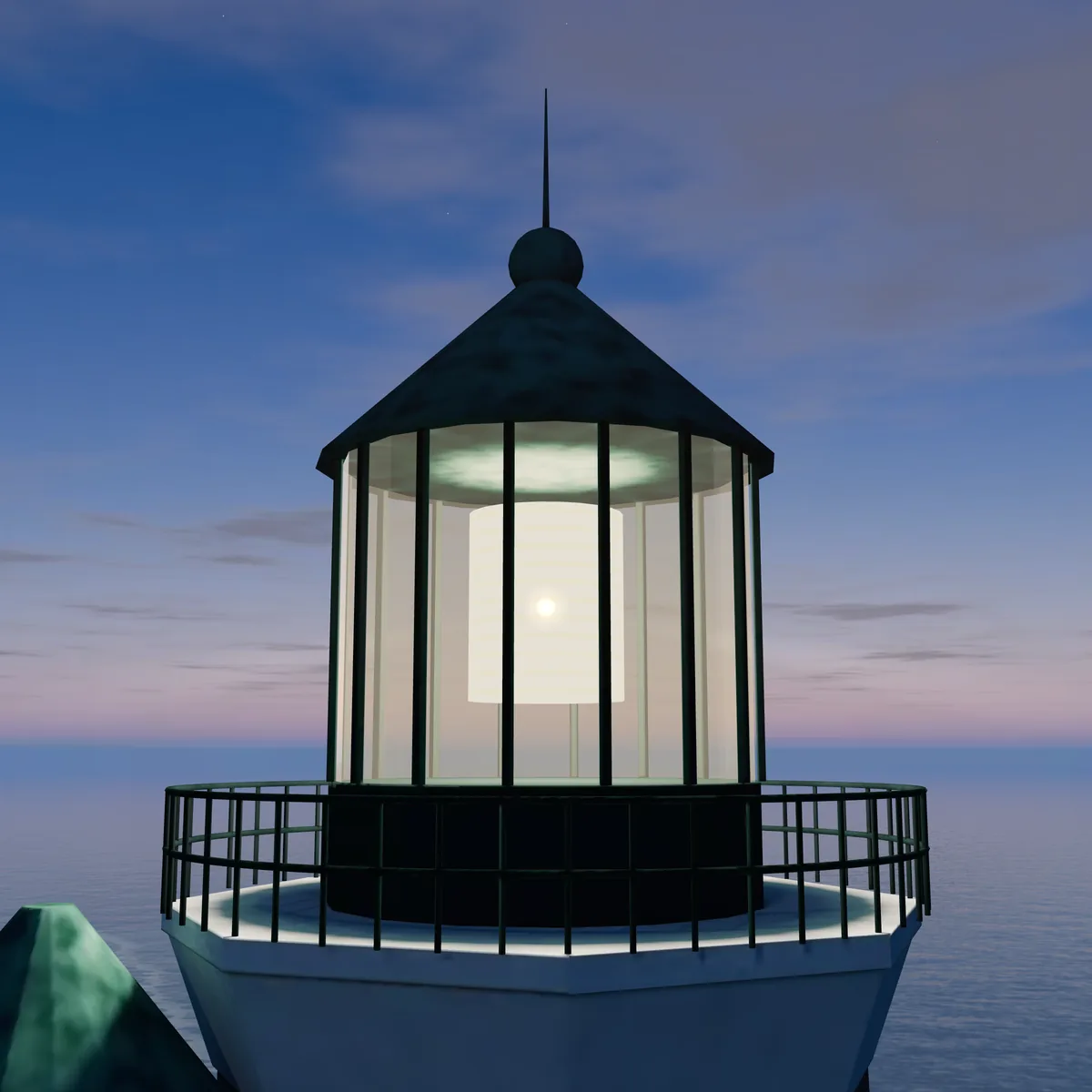
- Lantern: sixteen panes in a cast-iron frame and a copper dome, green with patina today.
- Stair tower on the south side, a separate cylinder with the stairs, so that each floor of the main tower is left whole for a room.
- Keeper’s house, single-story, with the keeper’s room, a kitchen and the old office.
Six floors, 118 steps
For the first hundred years nobody slept in the tower: the floors held barrels of kerosene, spare panes and tools, and the keeper and his family lived in the house next door. When the light was automated, the storerooms emptied. In 2021 we turned them into five rooms, one per floor.
- Ground floor
- Entrance, drying room and the old workshop. From here, 118 steps up.
- 1. Forecastle
- The old kerosene store; the walls still smell of the linseed oil they were sealed with.
- 2. Cabin
- Spare lenses and lantern panes. A window to the north, straight out to sea.
- 3. Mess
- Where the keepers ate during storm watches, when they didn’t go down to the house.
- 4. Chart Room
- Charts, logbooks and a 1956 radio set, the same one that stands in the keeper’s room today.
- 5. Crow’s Nest
- The watch room below the lantern, with three windows. The telescope stands where it always has.
Two flashes from one turn
The lens turns once every fifteen seconds. Around it are two panels that gather the lamp’s light into narrow beams. Each beam sweeps past your eye in 0.4 seconds, the second 2.4 seconds after the first. That makes the rhythm Fl(2) W 15s, by which a navigator picks out Mewia Kępa among the other lights of the coast.
- Rotation
- 360° in 15 s, or 24° per second. The lens table once floated on mercury; today it runs on a bearing.
- Panels
- The 2.4 s interval is 57.6° of rotation; a 0.4 s flash is a beam 9.6° wide.
- Range
- 21 nautical miles, about 39 km. From the deck of a yacht (eye 2 m above the water) the light rises over the horizon at about 19 miles.
- Source
- An LED lamp since 2019. Before that a 1,000 W bulb, and until 1938 a kerosene flame.
The keepers of Mewia Kępa
Since the first night in 1888, someone has written in the logbook when the light was lit and what the visibility was. There is only one gap in the logbook, from the war years.
| Years | Keeper | In the logbook |
|---|---|---|
| 1888–1919 | August Behrendt | Lights the lamp for the first time on October 1, 1888, at 17:41. Kerosene, a wick and a clockwork rotation mechanism wound every four hours. |
| 1920–1939 | Józef Konkel | The first Polish keeper at Mewia Kępa. In 1938 the tower gets electricity and a 1,000 W bulb. |
| 1939–1945 | — | The light is dark for most of the war. The last entry before the gap: ‘Visibility good. Light not lit.’ |
| 1945–1972 | Franciszek Myszk | Rebuilds the lantern, fits new panes and a radio set. Keeps the logbook in Kashubian and Polish. |
| 1972–2004 | Teresa and Jan Długi | In 1994 the light goes automatic. The keepers stay on: they clean the panes, grease the mechanism, keep the logbook. |
| since 2004 | Piotr Długi | LED in 2019, rooms in the tower in 2021. He still keeps the logbook, and guest bookings go into it like any other night. |
A keeper’s day today
- Morning
- An entry on putting out the light, weather and visibility, breakfast for the guests.
- Weekly
- Washing the sixteen lantern panes from inside and from the gallery.
- Monthly
- Greasing the rotation mechanism and timing the period with a stopwatch: it must be 15.0 s.
- Evening
- Checking the lamp before dusk and the entry: ‘Light lit.’